
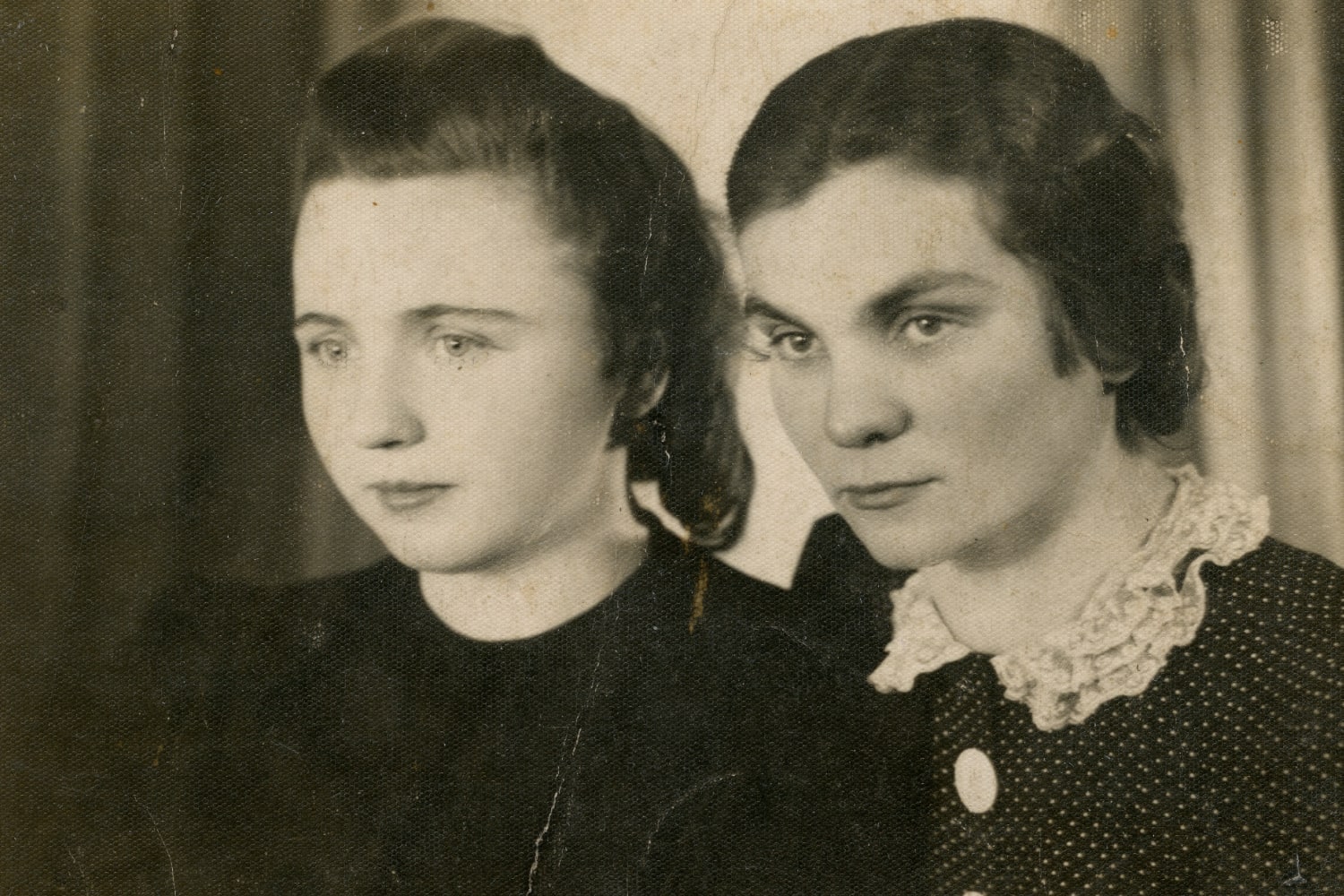
Helena Płotnicka (pseud. „Hela„, „Wilga” – on the right side of the photo) was born in 1902 in Strzemieszyce (Zagłębie Dąbrowskie). From there, the family moved to Brzeszcze, a move which enabled Helena’s father to avoid arrest by the tsarist police.
In 1932, Helena moved to Przecieszyn with her husband and four children.
She helped KL Auschwitz prisoners almost from the very establishment of the camp. Initially, she helped spontaneously, alone. Later, she enlisted the help of her friend Władysława Kożusznik. They were then sworn in and incorporated into the structure of the Peasants’ Battalions, becoming couriers for these units. Helena was also a courier for the Home Army’s Union of Armed Struggle.
In addition to supplying food, she carried illegal prisoner correspondence (secret messages), information about the conditions inside the camp, and messages for the underground press and radio stations.
On 19 May 1943, the Germans arrested her and imprisoned her in the Auschwitz „Death Block”. Despite months of investigation during which she was tortured, she did not reveal the names of the prisoners with whom she had collaborated. In October of the same year, she was imprisoned in the Birkenau women’s camp. She died in the camp hospital on 17 March 1944.
Władysława Kożusznik (pseud. „Włada”) was born in 1917 in Przecieszyn, where she lived before the war as well as during the occupation.
When KL Auschwitz was established, she joined in the relief effort for its prisoners. Together with Helena Płotnicka and others, she hid food near the camp for them. In 1941, she became a courier in the Peasants’ Battalions unit near the concentration camp. From then on, she supplied not only food, but also medicine, surgical instruments, and warm clothing. She also mediated in the exchange of illegal camp correspondence. She even managed to travel to what is now the Czech Republic, illegally crossing the border so that a letter from a prisoner could reach his family.
In 1943, after Helena Płotnicka, with whom she was active in the underground, was arrested, she hid for a year in Zagłębie Dąbrowskie and in Śląsk Cieszyński, fearing arrest.
After the war she was repeatedly interrogated by the Department of Security (the communist political police) in connection with her association with the underground movement.
For her activities she was awarded the Knight’s Cross of the Order of Polonia Restituta.
She died in 1998 and is buried in the municipal cemetery in Brzeszcze.
Photograph: Collection of Remembrance Museum of Land of Oświęcim Residents