
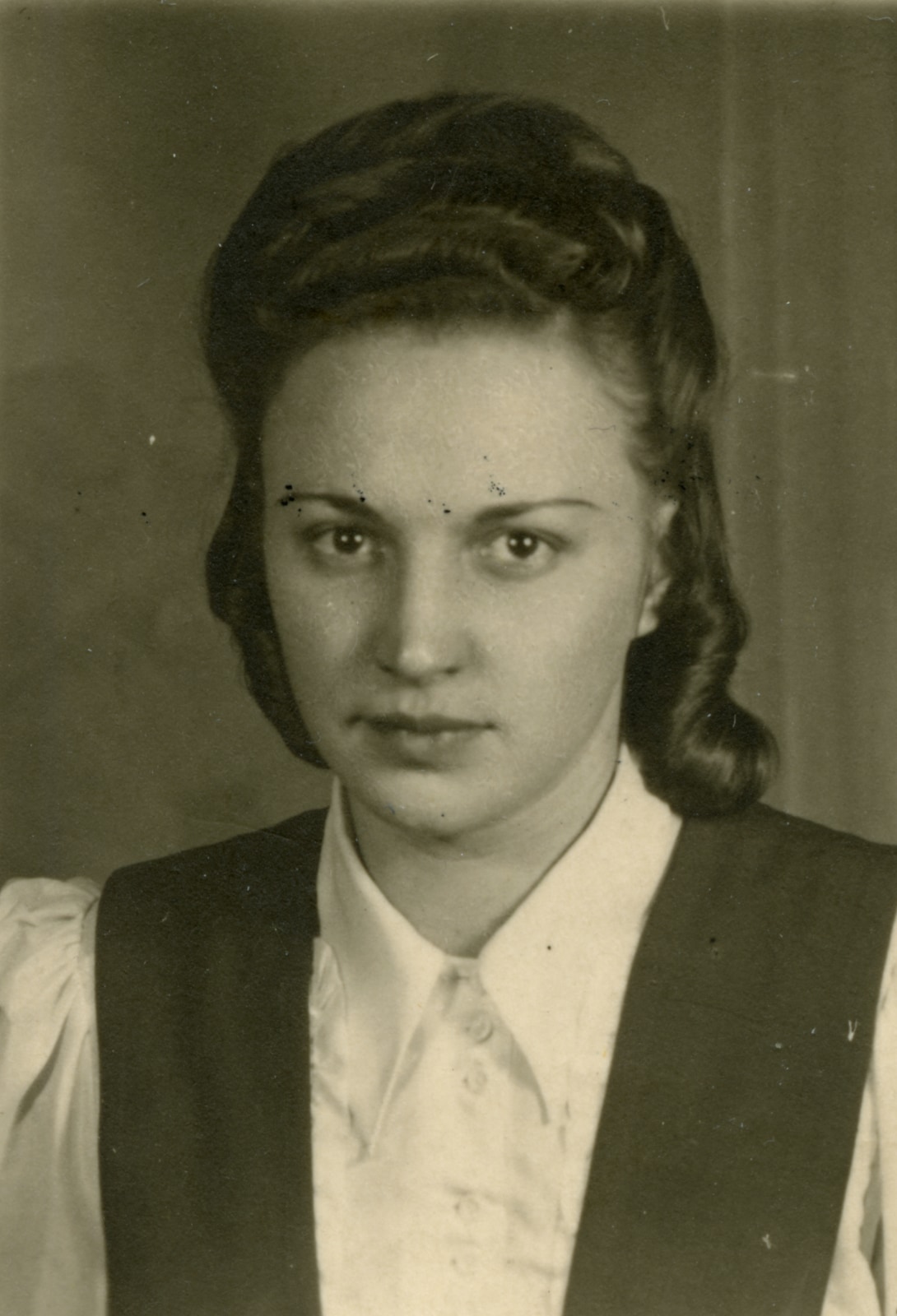
Zofia Gabryś, married name Domasik (pseudonym “Wera”) was born in Bielany near Kęty in 1921, where she lived with her family until 1941, when the Nazis resettled them to Łęki. She engaged in helping the prisoners of the nearby KL Auschwitz almost from its inception in 1940. At first, she acted spontaneously, collecting food and medicine for the inmates. The following year she made contact with a conspiratorial organization, and in the spring of 1942 became a sworn member of the Home Army and adopted the pseudonym “Wera.” Serving as a runner, she delivered dispatches to a number of localities, transferred weapons, and participated in taking supply drops organized by the Allied Air Forces, all the while continuing her assistance to KL Auschwitz prisoners. She continued to collect food, medicine or clothing for them, and also escorted escapees, leading them to hiding places prepared in advance.
At the time, conspiratorial activity involved enormous danger from which Zofia Gabryś and her relatives were not exempt. A Nazi informed on her and in November 1944 she was arrested, along with her mother and brother. Her father was shot on the spot.
After her arrest, she was repeatedly subjected to cruel torture at Gestapo headquarters in Oświęcim and on the grounds of KL Auschwitz. She was incarcerated in the notorious Block 11, where she awaited a hearing before a military martial court. However, the hearing that was to decide her fate did not take place. Due to the approaching Red Army troops, the head of the Katowice Gestapo, who presided over such hearings, did not dare to come to KL Auschwitz.
Along with other prisoners, she was evacuated in the “death march” on 18th January 1945. However, she managed to escape from it in Jastrzębie Zdrój and, after a few weeks of necessary convalescence, returned to Bielany, where she was reunited with her mother and brother.
The end of the German occupation did not mean freedom for Zofia Gabryś, however. First the Soviet NKVD (The People’s Commissariat for Internal Affairs) took an interest in her, and later the Polish political police, the so-called Department of Security. Surveillance and harassment continued until 1946.
Zofia Gabryś was decorated many times for her underground activities, including with the Knight’s Cross of the Order of Polonia Restituta.
She died in 2009 and was laid to rest at the municipal cemetery in Oświęcim.