
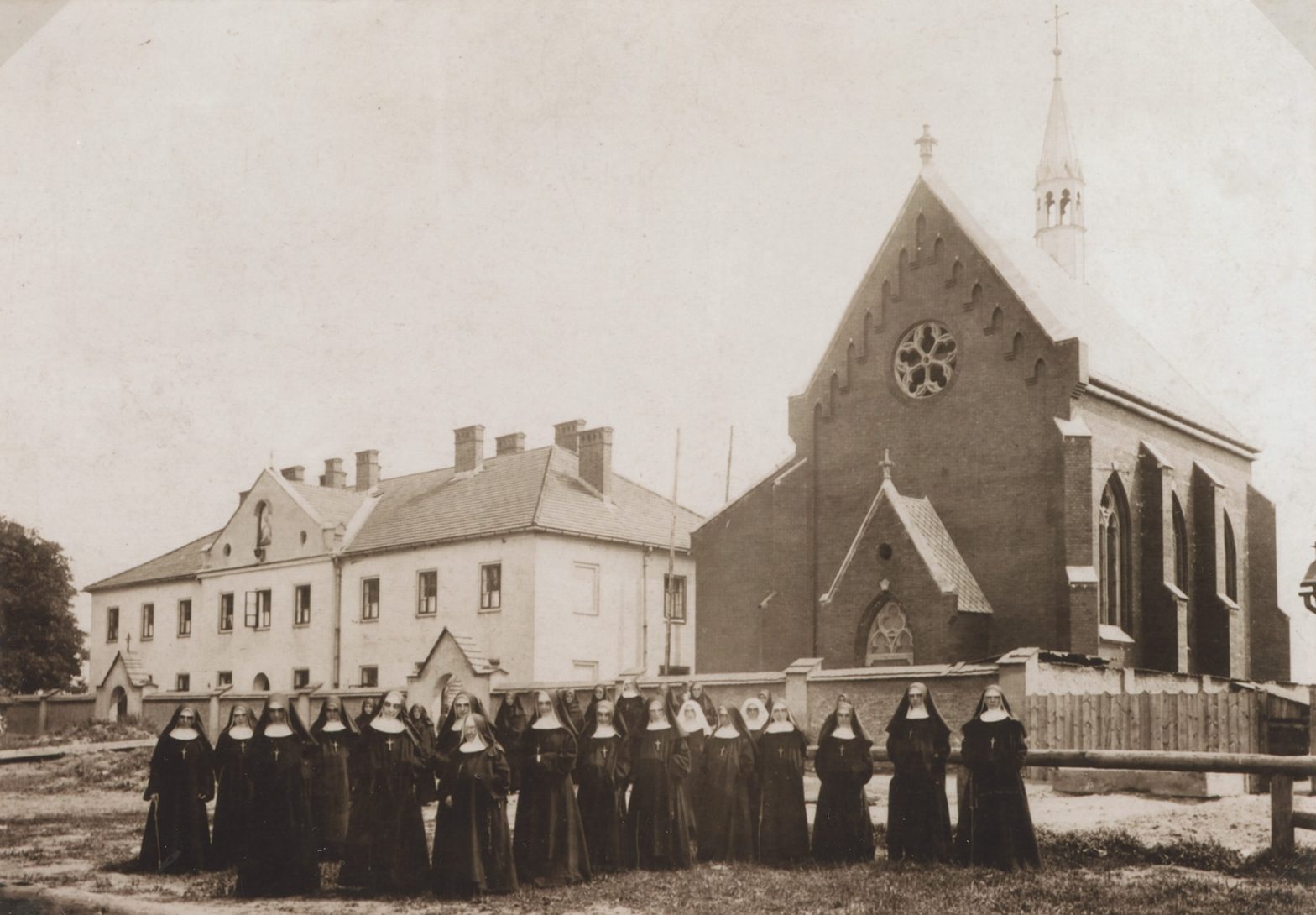
The Seraphite Sisters in front of their church and convent. Oświęcim, 1900
– archives of the Seraphite Sisters / archive of Tadeusz Firczyk / collection of The Remembrance Museum of the Land of Oświęcim –
In 1881, a new religious congregation without a habit was founded in the Polish lands under the name Little Sisters of the Poor. It was established through the joint initiative of Blessed Honorat Koźmiński and Blessed Mother Małgorzata (Łucja Szewczyk).
The Sisters chose Oświęcim as the site of their mother house. In 1891, they adopted religious habits and soon began using their official name: the Congregation of the Daughters of Our Lady of Sorrows, commonly known as the Seraphite Sisters.
After arriving in Oświęcim in the 1890s, the Sisters began extensive charitable work. They established a care home for the elderly and people with disabilities, as well as a kindergarten, an orphanage, and centers for work and vocational training.
During the German occupation in World War II, the Seraphite Sisters provided assistance to prisoners of the German Nazi concentration camp Auschwitz (KL Auschwitz).
They organized food for prisoners, including bread, butter, and lard. These provisions were left in hiding places near sites where prisoners were forced to perform hard labour.
The Sisters also smuggled medicines into the camp, including typhus vaccines. During harsh winter conditions, they provided prisoners with warm clothing such as sweaters, scarves, and socks.
At Christmas in 1940, when the Nazi authorities permitted only limited, one-time aid for prisoners of KL Auschwitz, the Sisters prepared and sent as many as 300 aid parcels.
They also cared for a group of orphaned children whose parents had been imprisoned in the camp. Those who managed to escape from KL Auschwitz often found shelter within the convent walls of the Seraphite Sisters.
For their courageous actions, the Sisters were subjected to numerous aggressive searches carried out by German authorities within the convent.
In January 1945, at the end of World War II and following the liberation of KL Auschwitz, the Seraphite Sisters provided medical care to prisoners who, due to their condition, were unable to take part in the evacuation forced by the Germans—known as the Death March.